


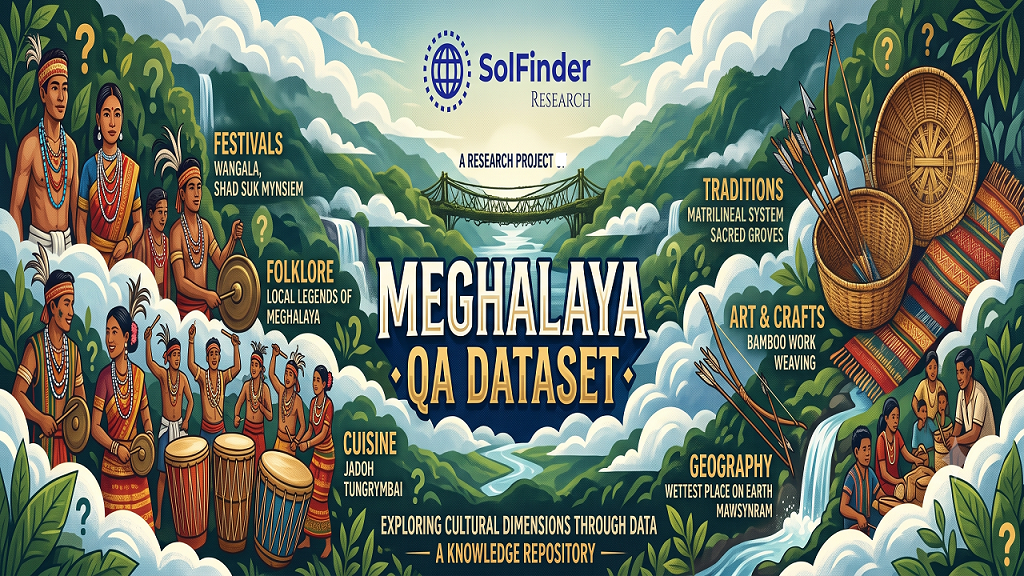
Meghalaya QA Dataset
Meghalaya QA Dataset contains comprehensive information about Meghalaya, covering various aspects such as history, geography, culture, economy, governance and more.
About Dataset
Meghalaya Question Answer (QA) Dataset is a comprehensive collection of data about Meghalaya, covering multiple aspects including history, geography, culture, tourism, administration, education, economy, and more. The dataset has been categorized across the following domains: History (इतिहास - 124 pairs): Chronicles Meghalaya's political and historical evolution, covering the Hill State Movement, the All Party Hill Leaders Conference (APHLC), the transition from an autonomous sub-state in 1970 to full statehood in 1972 under Prime Minister Indira Gandhi, colonial-era Shillong as the former capital of undivided Assam, tribal chieftains (Syiems), and key leaders such as Captain Williamson A. Sangma. Geography (भूगोल - 119 pairs): Maps the physical terrain of the Meghalaya plateau, detailing regional topography across the Khasi, Garo, and Jaintia Hills, major river basins (e.g., Umngot, Simsang, Kynshi, Bugi), international borders with Bangladesh, interstate boundaries with Assam, karst formations, and the geological significance of the global "Meghalayan Age" defined from Mawmluh Cave. Culture (संस्कृति - 112 pairs): Curates the unique matrilineal traditions of the Khasi, Jaintia, and Garo communities, highlighting customary lineage practices (e.g., Khadduh and Nokrom), traditional attire (e.g., Jainsem, Dhara), indigenous culinary heritage (e.g., Jadoh, Tungrymbai), and major cultural festivals such as Shad Suk Mynsiem, Nongkrem Dance, and the Wangala Hundred Drums festival. Tourism (पर्यटन - 111 pairs): Highlights Meghalaya's iconic travel destinations and natural wonders, including the UNESCO tentative-listed Living Root Bridges (Jingkieng Jri), Dawki's crystalline Umngot River, Cherrapunji (Sohra) and Mawsynram, Mawlynnong village, major waterfalls (e.g., Nohkalikai, Seven Sisters, Phe Phe Falls), and extensive karst cave networks like Krem Liat Prah and Krem Puri. Administration (प्रशासन - 106 pairs): Covers the constitutional and governance structure of Meghalaya, detailing the 60-member Legislative Assembly, Parliamentary constituencies, Autonomous District Councils (KHADC, JHADC, and GHADC) functioning under the Sixth Schedule, administrative districts, state executive leadership, and police and judicial administration. Wildlife and Environment (वन्यजीव और पर्यावरण - 102 pairs): Details the state’s rich biodiversity hotspots, focusing on Nokrek National Park and Biosphere Reserve (home to Citrus Gene Sanctuary), Balpakram National Park, sacred groves (such as Mawphlang Sacred Forest), wildlife sanctuaries, endemic flora and fauna, and vital conservation corridors. Economy (अर्थव्यवस्था - 102 pairs): Focuses on the state's economic, mineral, and agro-horticultural profile, highlighting GI-tagged commodities like Lakadong Turmeric and Khasi Mandarin orange, organic spices, indigenous bee-keeping and honey production, coal and limestone resources, border trade routes, and industrial zones. General Knowledge (सामान्य ज्ञान - 92 pairs): Provides factual insights on state insignia—including the Clouded Leopard (State Animal), Hill Myna (State Bird), Lady's Slipper Orchid (State Flower), and Gamhar (State Tree)—alongside the state anthem, transport infrastructure such as Mendipathar railway station, administrative blocks, and key regional milestones. Education (शिक्षा - 50 pairs): Documents the academic ecosystem of Meghalaya and Shillong's legacy as an educational hub of the Northeast, featuring premier universities and institutes such as North-Eastern Hill University (NEHU), IIM Shillong, Lady Keane College, St. Anthony's College, and the Meghalaya Board of School Education (MBOSE). Sports (खेलकूद - 46 pairs): Highlights traditional and modern sports culture, featuring indigenous archery traditions like Siat Khnam (Shillong Teer), traditional wrestling, adventure off-roading, Meghalaya State Olympic Association initiatives, and the state's football legacy and prominent athletes. Literature (साहित्य - 36 pairs): Explores the linguistic and literary heritage of the Khasi (Mon-Khmer family), Garo (Tibeto-Burman), and Pnar languages, commemorating foundational literary figures such as U Soso Tham, the Khasi Authors' Society (KAS), and pioneering regional periodicals and folk literature anthologies.
Purpose of Dataset
To provide comprehensive information about Meghalaya, covering diverse domains such as history, geography, culture, economy, governance and more. Use cases: 1. Education: Develop more effective teaching materials for students in Meghalaya. 2. Governance: Inform the development of policies and programs aimed at addressing the needs of the people. 3. Business: Better understand the needs of customers in Meghalaya and develop more effective marketing strategies. 4. Research: Conduct studies related to topics concerning Meghalaya. The dataset can be used for fine-tuning and benchmarking Large Language Models (LLMs) on state-specific geography, administration, culture, and socioeconomic structures.
 Dataset Metadata
Attribution 4.0 International (CC BY- 4.0)
Meghalaya
Sector Agnostic
Prateek Khanna

Structured
Static
NA
N.A.
06/09/26 13:43:58
Open
Hosted
Hybrid
 Activity Overview
 0
 4
 282.73 KB
 26
 Tags
- Meghalaya
- dataset
- Question answering
 License Control
Attribution 4.0 International (CC BY- 4.0)

Select a file to preview its contents.
 Data Quality Score Beta
 Version Control
 Version 1(282.73 KB)
- Prateek Khanna·1 month(s) ago

Meghalaya_QA_Dataset1.csv
© 2026 - Copyright AIKosh. All rights reserved.