

IndiaAI Innovation Challenge 2026 (MSME – ODR)
Launched in partnership with the Ministry of Micro, Small and Medium Enterprises (MSME) - Online Dispute Resolution Portal to build AI powered digital dispute resolution ecosystem in the country.
IndiaAI
MSME - ODR
Description
About the Challenge
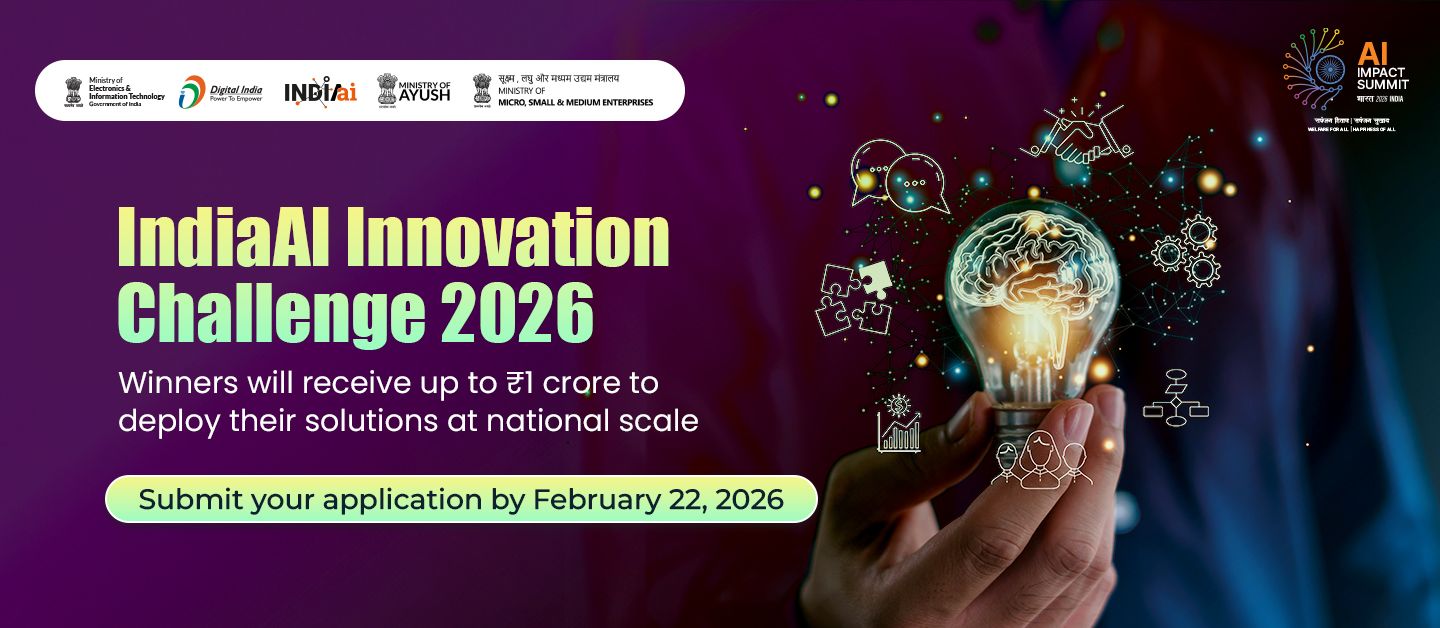
The IndiaAI Innovation Challenge 2026, in partnership with the Ministry of MSME and the Ministry of AYUSH, invites market-ready AI solutions to address high-impact public sector challenges in MSME governance and AYUSH-enabled public health systems.
The Challenge aims to identify, pilot, and scale AI solutions within government systems to strengthen service delivery, improve institutional efficiency, and enable data-driven decision-making in collaboration with Line Ministries.
Selected innovators will receive structured pilot and deployment support, with an opportunity to secure a two-year government work contract of up to INR 1 crore, subject to performance and scope alignment.
Challenge Objective
To identify market-deployed AI solutions with strong potential for refinement and adaptation to address the defined problem statements in collaboration with the concerned Line Ministries.
Proposed solutions must demonstrate the ability to:
- Analyse complex datasets and generate actionable insights
- Support predictive and decision-making processes
- Integrate with existing digital systems
- Ensure scalability, security, and deployment readiness
- Comply with national data protection and cybersecurity frameworks
- Enable long-term adoption within public sector environments
Expected Output
- MSME - Virtual Negotiation Assistance: AI-enabled virtual assistants for MSME digital dispute resolution, supporting automated intake, document analysis, outcome prediction, multilingual interaction, and assisted settlement drafting.
- MSME - Intelligent Agent Mapping: AI-driven tools for automated onboarding, classification, and intelligent matching of vendors and entities based on attributes, capabilities, and operational requirements.
- Intelligent AYUSH Health Systems: AI-based platforms for disease trend detection, public health risk forecasting, and personalised treatment and lifestyle recommendations using large-scale historical data.
Who Can Apply?
- Indian Companies registered under the Companies Act, 2013, with at least 51% Indian ownership
- Start-ups recognised under DPIIT guidelines
- Autonomous Bodies, including public sector organisations, research institutions, universities, and non-profit organisations
- Individuals, including Indian students, researchers, and working professionals affiliated with recognised institutions
Note: Applicants must be Indian citizens. Teams not registered as a company or start-up may apply; however, they will be required to register as a Company or Start-up if they are selected for stage 2 solution refinement and pilot.
Major Milestones
Stage 1: Initial screening and technical evaluation
Stage 2: Shortlisting of up to three teams per problem statement; each selected team will receive INR 25 lakh to refine and pilot the solution with relevant government stakeholders
Stage 3: Selected teams may secure a two-year work contract of up to INR 1 Crore for integration, deployment, operation, and maintenance of their solution within government systems.
Submission Guidelines
For more information, please refer to the detailed submission guidelines for IndiaAI Innovation Challenge 2026.
Queries:
All pre-submission queries must be emailed to fellow3.gpai-india@meity.gov.in using the subject line: “Query-IndiaAI Innovation Challenge 2026 –Applicant Name”


- 15 Jan 2026Application Open
- 2 Mar 2026Application closed
 Tags
Tags
- ASR
- Natural Language Processing
- Named Entity Recognition
- sentiment-analysis
- MSME
- Optical Character Recognition
- segmentation models
- Classification models
- semantic mapping
- prediction models
- Conversational AI agents
- Clustering and capability assessment models
- ensemble learning
- reinforcement learning and hybrid recommendation architectures
- negotiation assistant
- AYUSH
- Text-to-Speech
© 2026 - Copyright AIKosh. All rights reserved.